

Allá en el Rancho Grande follows the love triangle and relationships between José Francisco, Felipe, and Cruz on el Rancho Grande. The movie begins in the past when the mother of José Francisco and Eulalia is ill and passes away. At the time, an orphan named Cruz was living with them as being raised almost as another sibling. They are left in the care of their godmother, Ángela, who agrees to raise them as her own. The film then shifts to the present as José Francisco is promoted to “el corporal” of the ranch and Felipe, his childhood friend, becomes “el patrón”. The audience learns that Felipe intends on marrying Cruz, yet she and José Francisco are secretly in love. After a lot misunderstanding and emotional moments, everything falls into place with the perfect ending to this comedia ranchera.
Explanation for film still of choice: This is representative of the film for multiple reasons. First, Cruz is placed behind bars which can be seen as a physical representation of the way Ángela kept her locked up and in the shadows. The viewer can even compare this to the balcony in Romeo and Juliet. Additionally, both José Francisco and Martín seem to be looking longingly at Cruz, but her gaze is only directed at José. This framing appropriately represents the love triangle between Cruz, José Francisco, and Felipe.
Explanation of movie poster: In the background of the poster, the audience again sees the scene shown in the film still representing the entrapment of Cruz and the love triangle carried out in the plot. In the foreground, we see what appears to be José Francisco with his arm draped over Cruz’s shoulder. This pairing shows the audience the true love between these two characters.

Describes the setting of a scene in a play or a film. It refers to everything placed on the stage or in front of the camera—including people. In other words, mise en scène is a catch-all for everything that contributes to the visual presentation and overall “look” of a production. When translated from French, it means “placing on stage.”
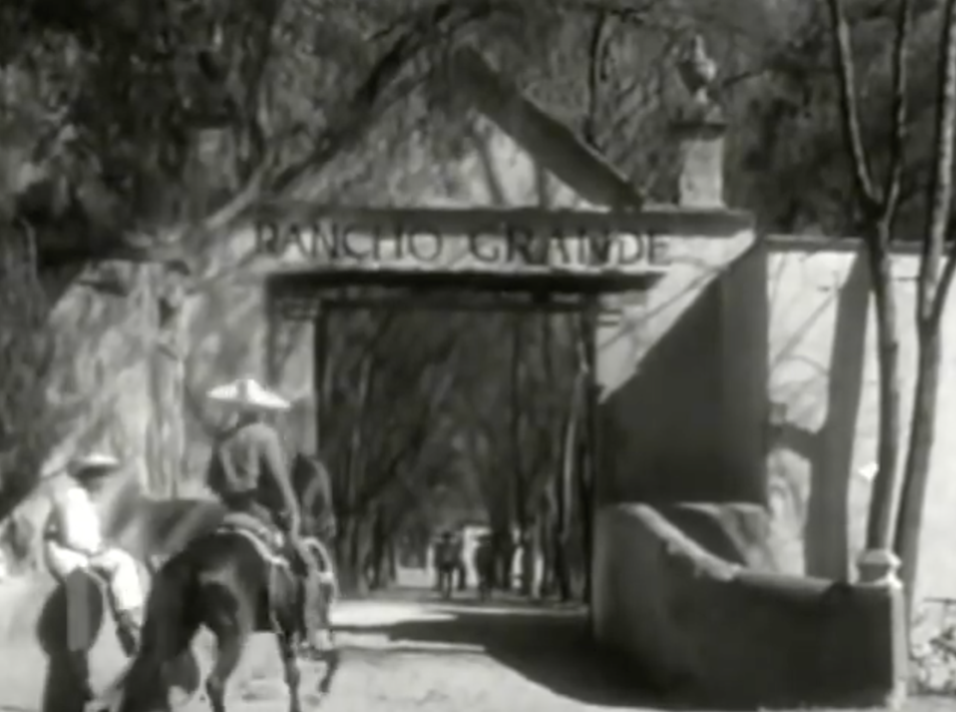
Analysis of Still 1: This still is at the beginning of the film and is supposed to show the entrance to “el Rancho Grande”, where the film takes place. Everything about this image is very perfect and organized. It seems as though the entrance is perfectly centered with even rows of trees on either side of the trail.
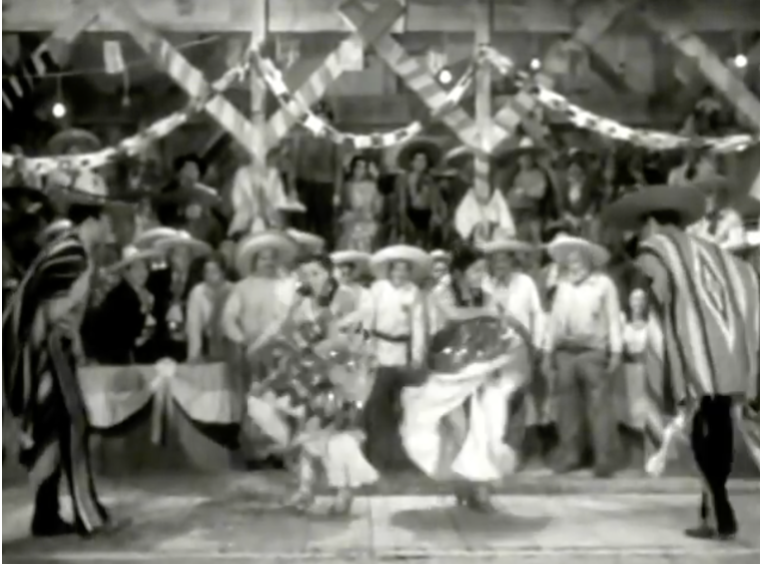
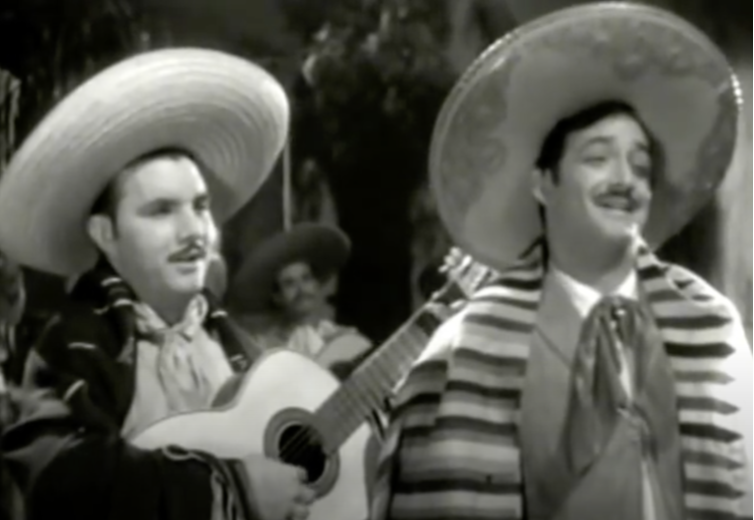
Analysis of Still 2: Although it might be difficult to tell in this still, this moment in the movie seems to glorify what people that work on a ranch do. This scene in the film revolves around a fight between chicken from el Rancho Grande and el Rancho Chico. Before the fight, there are performances by a mariachi band and by two couples engaged in traditional Mexican dance. This still in particular is very evenly spaced and almost looks symmetrical over the center of the image, something not very possible in movies filmed on location. The photo illustrates the idealized representation of what occurs on Mexican ranches.
Analysis of Stills 3 and 4: In the beginning of the movie, we see the set decorated with papel picado, which is iconic to Mexican culture, and we also see mariachi playing. The placement of these things adds familiarity for Mexican viewers, emphasizes the Mexican setting, and it additionally helps show the wealth of the patrón. He is able to host a party with all these decorations for his workers. The nice setting alludes to his wealth, allowing the audience to visualize his higher socioeconomic status.

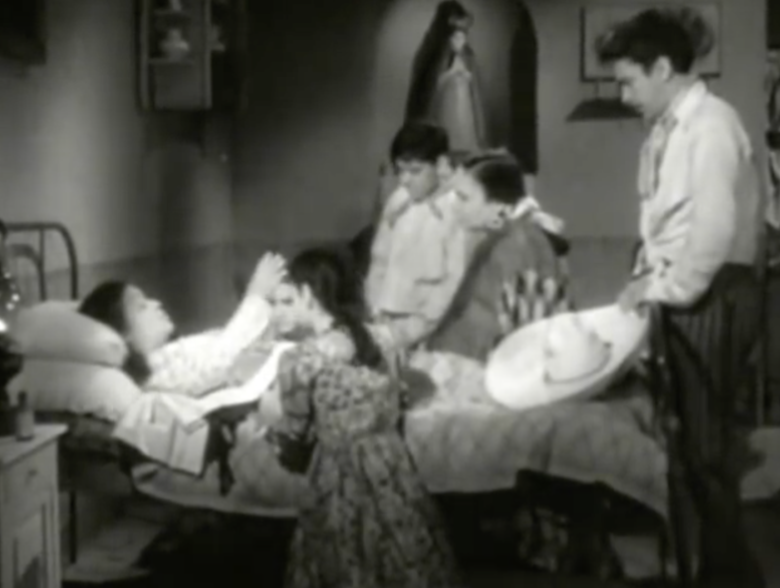
We chose eye light as you have a light directly facing the mother from behind the camera, instead of from behind the actors.
Still 1(00:07:21-00:10:25): Most of the scene in this still is in shadow, except for the mother of José Francisco and Eulalia. At this moment she is praying for her family and friends by making the sign of the cross in the air. The light represents the religion and the pureness in her.
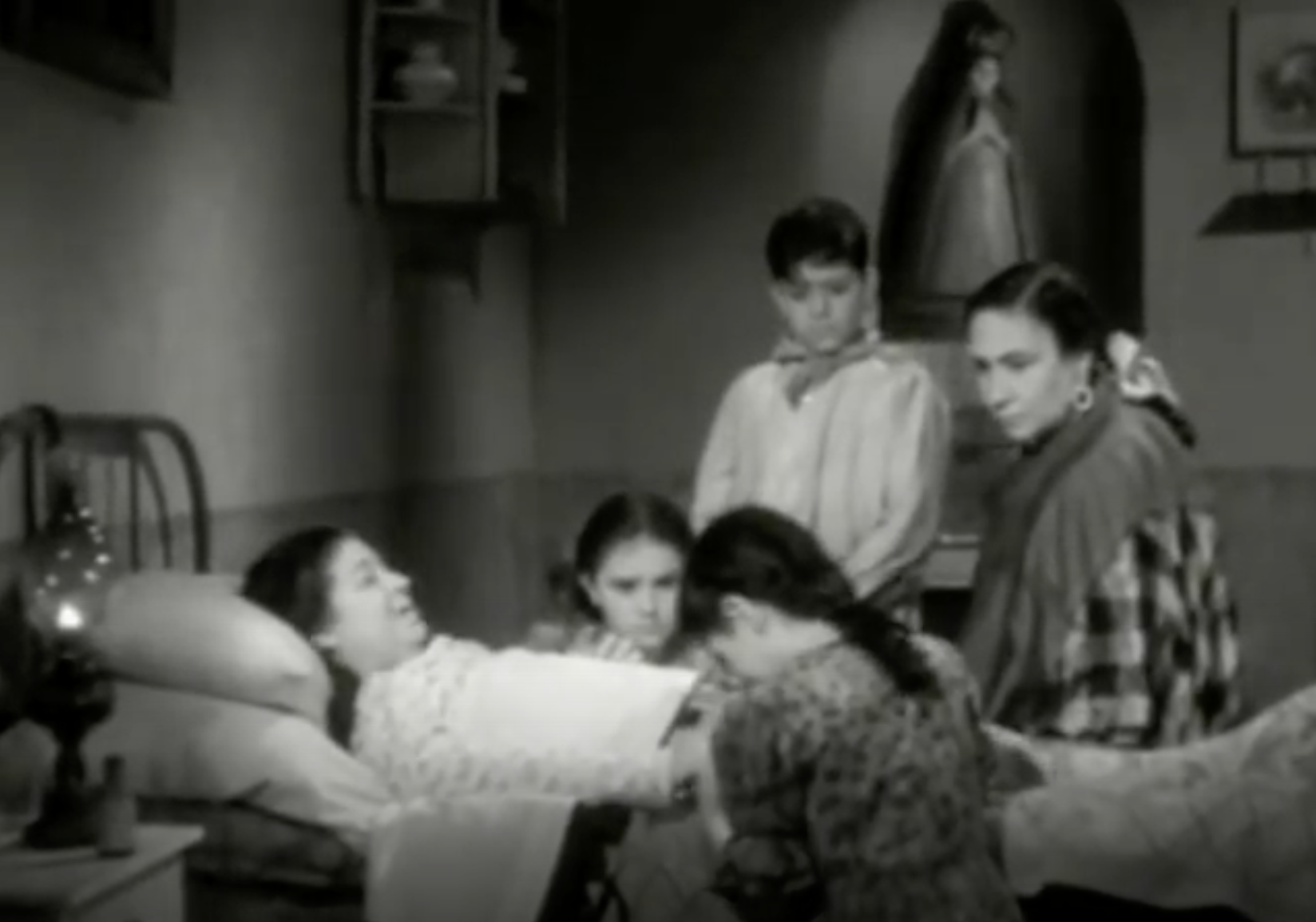
Still 1 (00:08:46): This still represents the lack of love for Cruz by Ángela. The way the actress portraying Ángela has a good way of showing her disdain for taking care of an orphan. Her face seems to lack any sort of expression as she looks at the crying child. This still in particular is able to contrast the love and warmth coming off the mother with the stern gaze of Ángela.
Still 2 (00:32:00): In this still, José Francisco’s eyes show a “drunk in love” kind of look. You can see the unwavering love and passion he feels towards Cruz, which allows the viewer to see the true love between them and thus encourages the viewer to root for that couple.
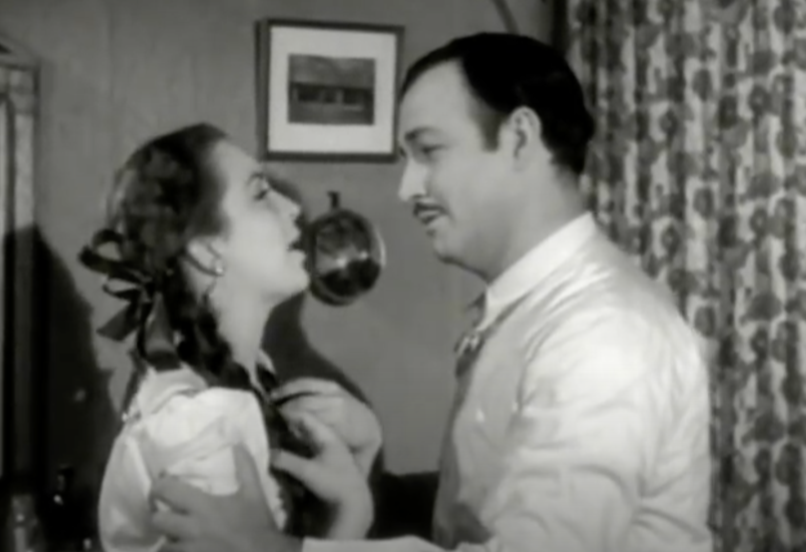
Still 3 (00:22:31): You can also see the way the two actors portray love in this still. She has her head directed up towards him, with their eyes fixed on each other, and Cruz shyly touching her hair. They look at each other with endearment and care, and even her voice gets softer when talking to him. This acting emphasizes and helps cement the bond between them. Even José Francisco’s reassuring grip on her shows just how much these two care for each other.
This is the art of photography and visual storytelling in a motion picture or television show. Cinematography comprises all on-screen visual elements, including lighting, framing, composition, camera motion, camera angles, film selection, lens choices, depth of field, zoom, focus, color, exposure, and filtration. Cinematography sets and supports the overall look and mood of a film’s visual narrative. Each visual element that appears on screen, a.k.a. the mise-en-scène of a film, can serve and enhance the story—so it is the cinematographer’s responsibility to ensure that every element is cohesive and support the story. Filmmakers often choose to spend the majority of their budget on high-quality cinematography to guarantee that the film will look incredible on the big screen.
Editing is the process of putting a film together–the selection and arrangement of shots and scenes. Editing can condense space and time, emphasize separate elements and bring them together, and organize material in such a way that patterns of meaning become apparent. In addition, editing can determine how a film is perceived: for instance, quick, rapid cuts can create a feeling of tension, while a long take can create a more dramatic effect. The first photoplays generally had no cutting, owing to the fact that they were single-reel films; once filming began, you could not stop until the film ran out. (https://filmglossary.ccnmtl.columbia.edu/term/editing/)
Sound is an integral part in a film. It refers to everything that the audience hears including sound effects, words and music. Sound is used in films for various purposes, including: providing the information to the viewer about the location of the scene, heightening the mood, telling the audience about the characters and advancing the plot. Every person who watches a film realizes that the choice of voices, soundtrack and music present in a film affect the way that the viewer perceives a particular film. As a result, the sound is an important and integral element of the film, one that determines the way that the viewer experiences and understands a film as a visual experience.
Narrative analysis is an examination of the story elements, including narrative structure, character, and plot. A narrative can be considered to be the chain of events in a cause-effect relationship occurring in time and space. In order to analyze the narrative of a film, we need to first make the distinction between the plot of the film and the story of the film. This is sometimes referred to as the discourse and story of a film. Narrative may also be called the story thought story mainly refers to the events that describe the narrative.
Film genres are various forms or identifiable types, categories, classifications or groups of films. (Genre comes from the French word meaning "kind," "category," or "type"). These provide a convenient way for scriptwriters and film-makers to produce, cast and structure their narratives within a manageable, well-defined framework. Genres also offer the studios an easily 'marketable' product, and give audiences satisfying, expected and predictable choices. Genres refers to recurring, repeating and similar, familiar or instantly-recognizable patterns, styles, themes, syntax, templates, paradigms, motifs, rules or generic conventions.