La Cucaracha

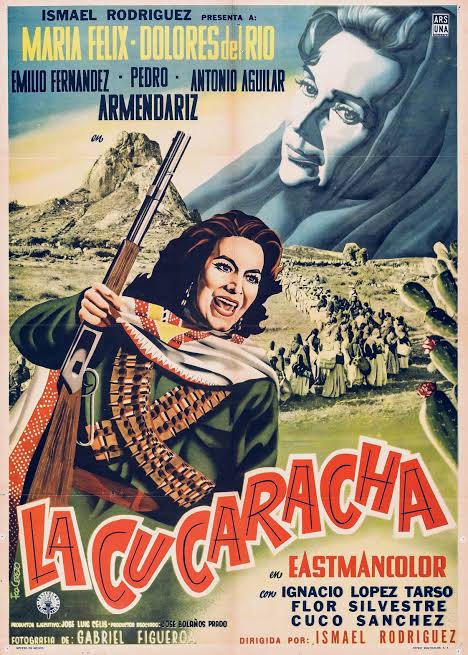
    Movie Poster
    Release year
    1959
    Director
    Ismael Rodríguez Ruelas
    Biography of director(s)
    Ismael Rodríguez Ruelas (October 19, 1917 – August 7, 2004) was one of the most prolific directors of the Golden Age of Mexican cinema, often called "el Cineasta del Pueblo." Born in Mexico City, he returned from Los Angeles in 1931 and founded a production company with his brothers. He launched Pedro Infante to stardom with Nosotros los pobres (1947) and directed Tizoc (1957), for which Infante won the Silver Bear at Berlin. His 1961 film Ánimas Trujano earned an Academy Award nomination. He returned to the Mexican Revolution as a subject across several films.
    Country
    Mexico
    Original synopsis of the film

    Set during the Mexican Revolution, La Cucaracha follows a soldadera named Cucaracha (María Félix), who has given herself so completely to Pancho Villa's army that fighting has become a part of her identity. That total commitment becomes a problem when Colonel Antonio Zeta, an officer she's clearly attached to, starts drifting toward Isabel (Dolores del Río), a woman recently widowed and pulled into the war by circumstance rather than any real conviction. The difference between the two women drives most of the film. Cucaracha has spent years earning her place in a world run by soldiers, while Isabel is still working out how to survive a war she never chose to be part of, and Zeta's divided attention turns that contrast into the story's central tension. As the fighting continues, Cucaracha becomes increasingly reckless, not really out of jealousy but because she's defending the identity she's built for herself, which is also the only real standing she has in a world that otherwise offers women very little. Rather than staying locked on that rivalry, though, the film keeps widening its focus to the soldaderas as a group, showing the women who fought, cooked, nursed the wounded, and buried the dead alongside the men, usually without getting credit for any of it. By the end, the film makes a case that the revolution wasn't carried only by the generals history remembers, but by the people who mostly get left out of that story. 
     

    Film Awards
    Nominated for the Palme d'Or (Golden Palm), 1959 Cannes Film Festival
    Film still
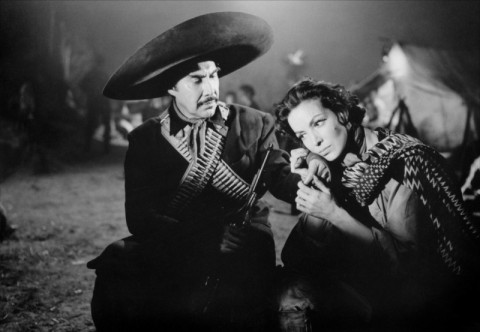
    Black-and-white still from La Cucaracha (1959) showing Colonel Antonio Zeta and Cucaracha in a tense exchange at a nighttime military camp.

    Describes the setting of a scene in a play or a film. It refers to everything placed on the stage or in front of the camera—including people. In other words, mise en scène is a catch-all for everything that contributes to the visual presentation and overall “look” of a production. When translated from French, it means “placing on stage.”
    Setting
    Setting
    Explanation
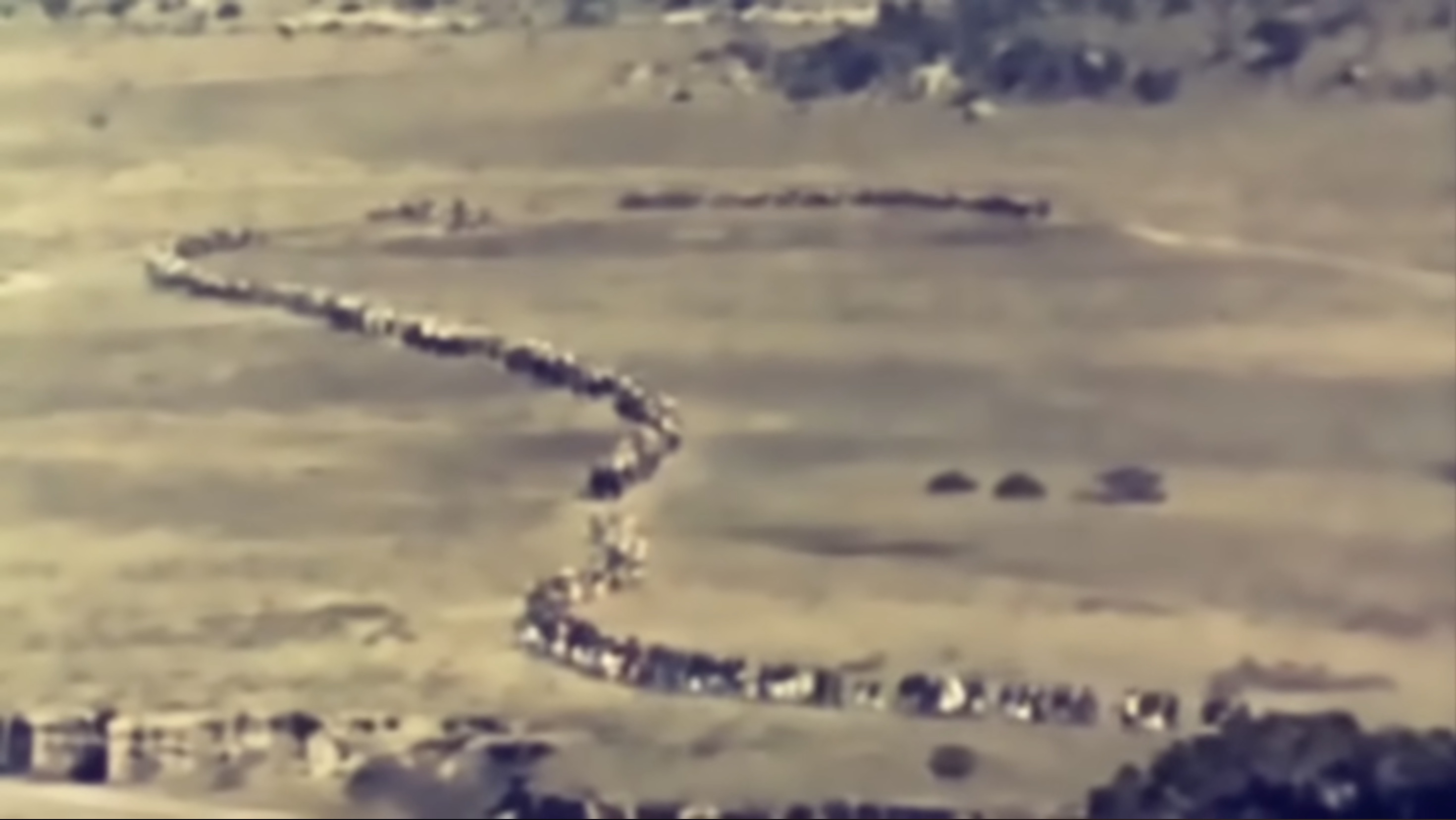
    Filmed in Durango, Mexico, as well as locations like Zacatecas and the Sierra de Órganos National Park in Sombrerete. This shot is filmed on location, and it's the widest, most open moment in the film. The camera pulls back to a high aerial angle and just watches a long column of Villa's soldiers snake across an empty, sun-bleached plain, the land stretching out in every direction with almost nothing breaking it up except a few scattered figures and trees at the edges of the frame. Rodríguez could have shot this march from the road or at eye level with the riders, but instead he pulls all the way back and lets the column shrink into a small, winding line against a landscape that doesn't care how important their cause is. That distance turns the revolution into something collective for a second, emphasizing scale and endurance instead of any individual soldier's face or motivation. It also reads less like a staged war movie and more like old newsreel footage, since the loose, unstaged composition and real terrain give it a documentary feel rather than a theatrical one. Given how much of the rest of the film hinges on the personal rivalry between Cucaracha and Isabel, this is a rare moment where the film steps back from the individual drama and reminds you what all of it is actually happening inside of.
    Timecode
    1:02:43
    Film Still
    Aerial shot from La Cucaracha (1959) showing a long column of Villa's soldiers on horseback winding across an open, empty plain.
    Props
    Timecode
    40:41
    Prop
    Flower
    Explanation
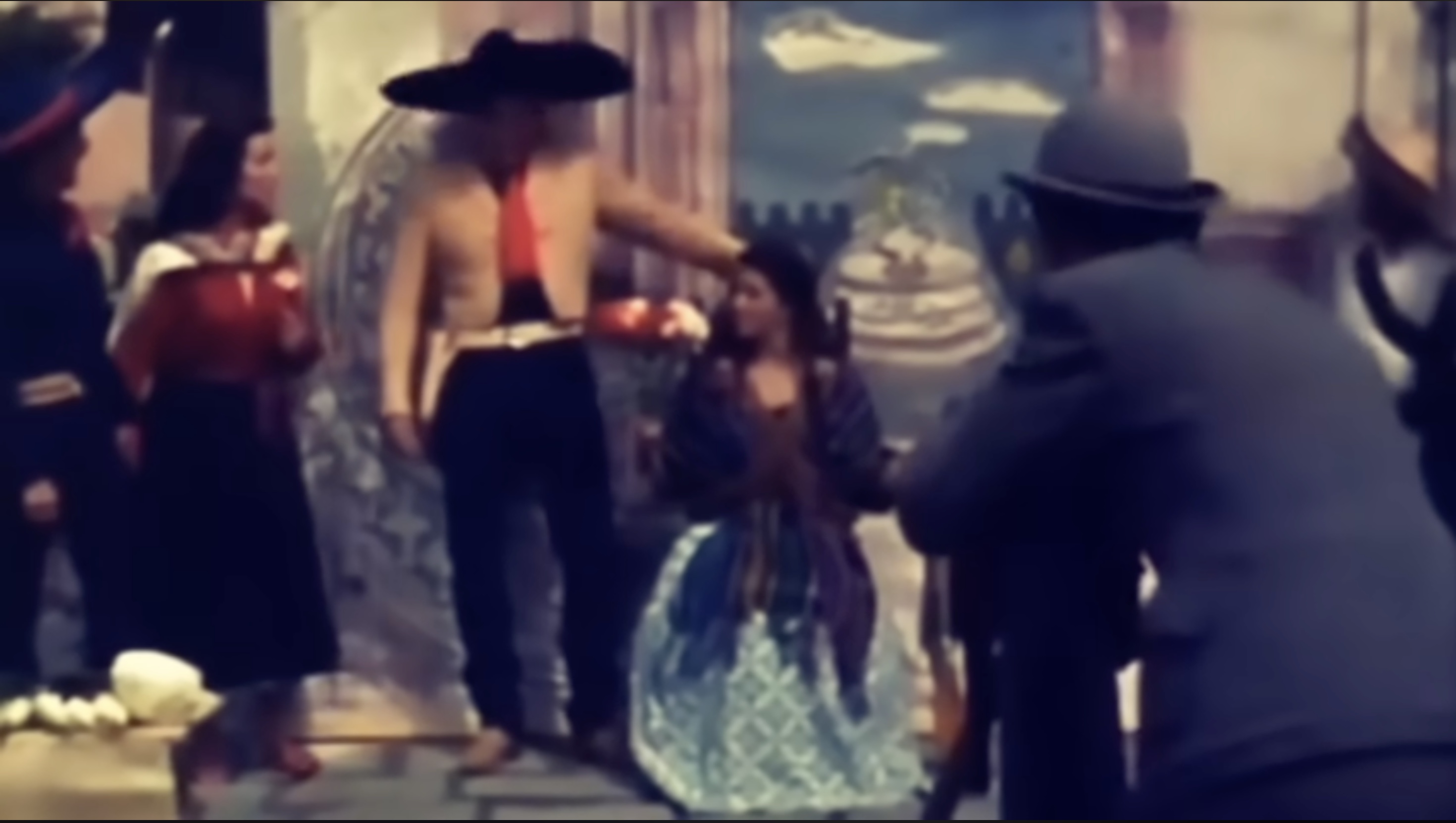
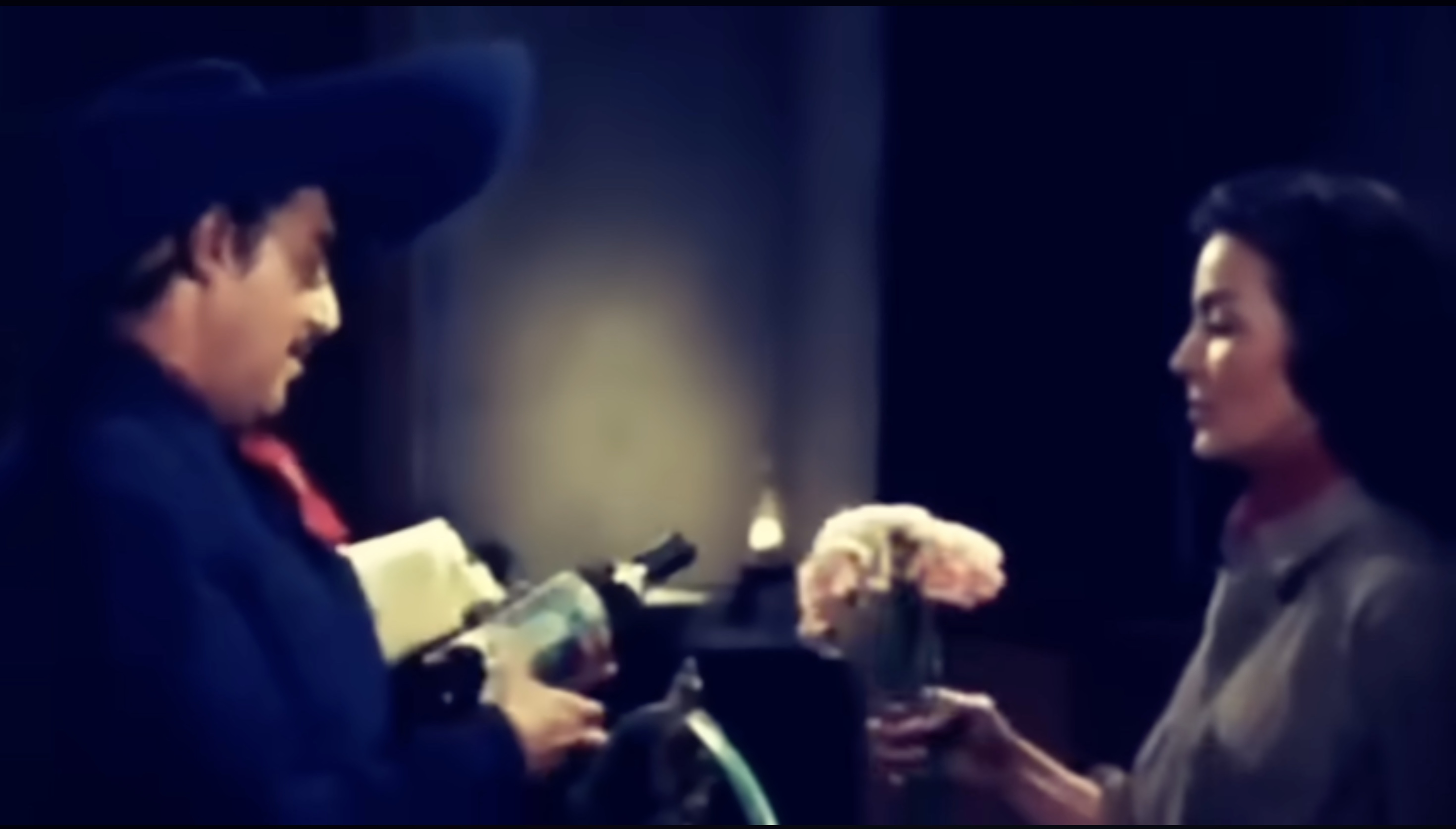
    A flower is visible near Isabel in this scene, and it recurs around her at other points in the film. It's a real symbolic thread tied to her character specifically, something that follows her the same way weapons and bandoliers follow Cucaracha. Cucaracha's defining objects are all markers of combat and hard-won status, things she's earned through fighting alongside men. Isabel's are soft, growing, and domestic, tied to a world that exists outside the war rather than inside it. The flower reinforces her as someone rooted in that gentler, civilian world, even as the fighting closes in around her and starts to pull her further into it. Its repeated appearance ties her to fragility and beauty in a way that never really goes away, even as her circumstances get harder. That's a deliberate contrast to Cucaracha's toughness, and it's one the film keeps coming back to every time the two women end up in the same scene together.
    Film Still
    Colonel Zeta and Isabel exchanging a flower.
    Still from La Cucaracha (1959) showing a man in a sombrero and Isabel in an ornate interior, with white flowers visible in the foreground and soldiers looking on.
    Lighting
    Lighting
    Explanation
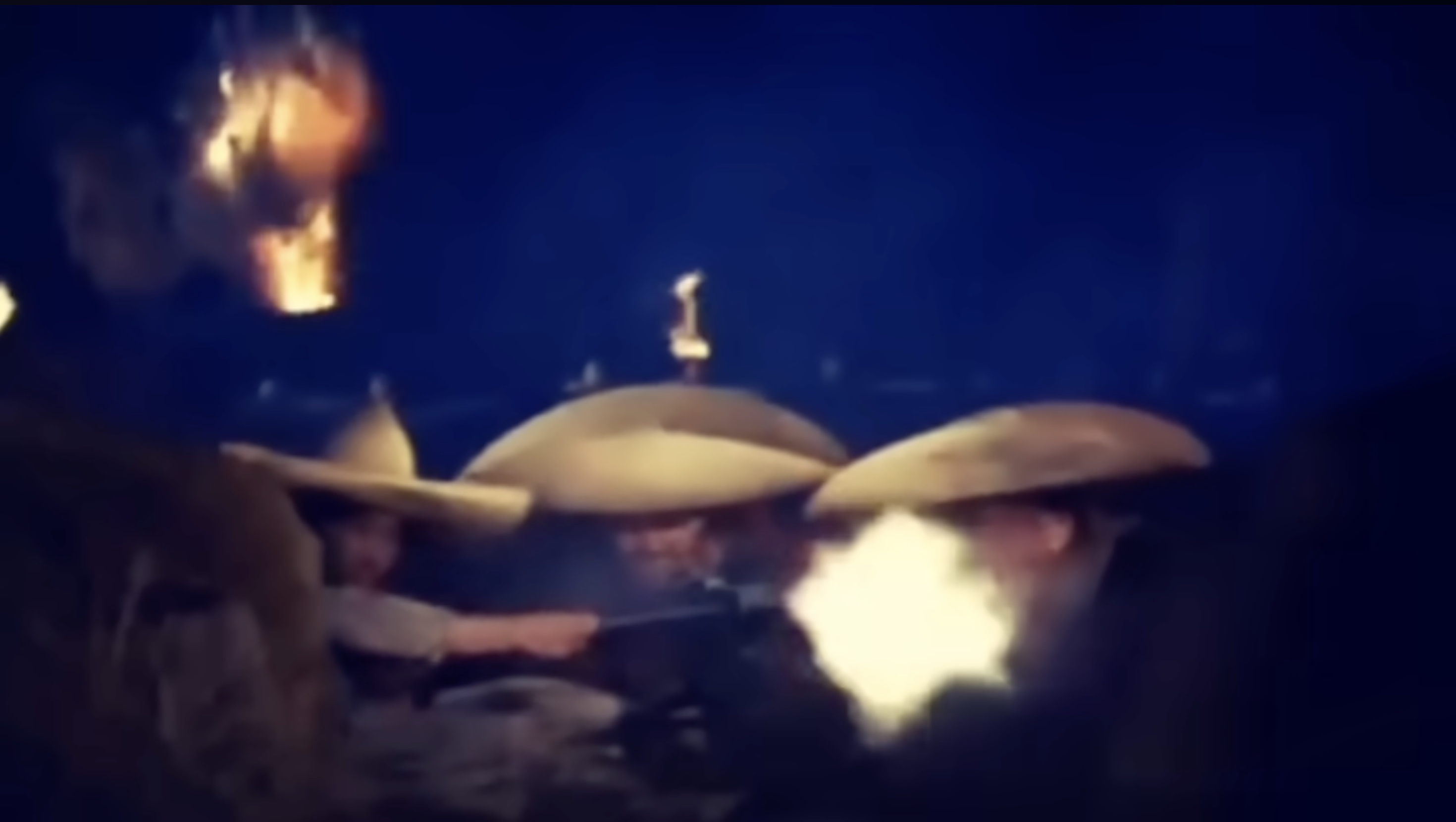
    This is a low-key scene, and the muzzle flash itself is doing almost all the lighting work. Two soldiers, faces framed under wide sombreros, fire directly toward camera against a nearly black night sky, and the light hitting their faces comes entirely from the gunfire, not from any conventional source like a lamp or moonlight. There's a small fire burning in the background too, but it barely registers next to the flash. Using the gunfire itself as the light source pulls the eye straight to the violence happening in the frame, since it's literally the only thing generating light. It also isolates the soldiers from everything around them, cutting them off from any sense of a wider battlefield and narrowing the moment down to just the act of firing.
    Timecode
    30:52
    Film Still
    Still from La Cucaracha (1959) showing two soldiers in wide sombreros firing weapons at night, their faces lit by the muzzle flash against a dark sky.
    Costume
    Costume
    Cucaracha's patterned poncho vs. soldier and civilian dress
    Explanation
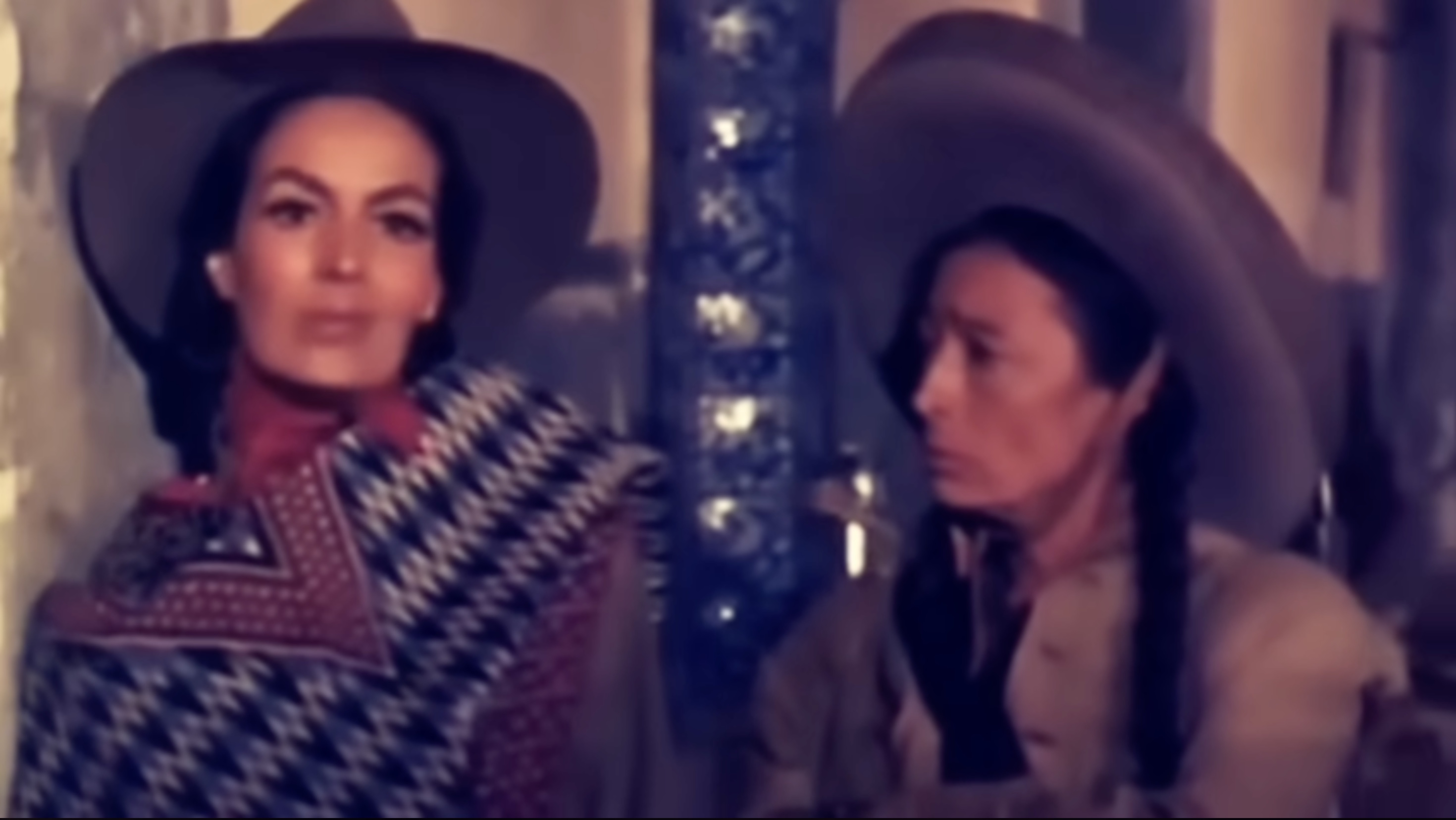
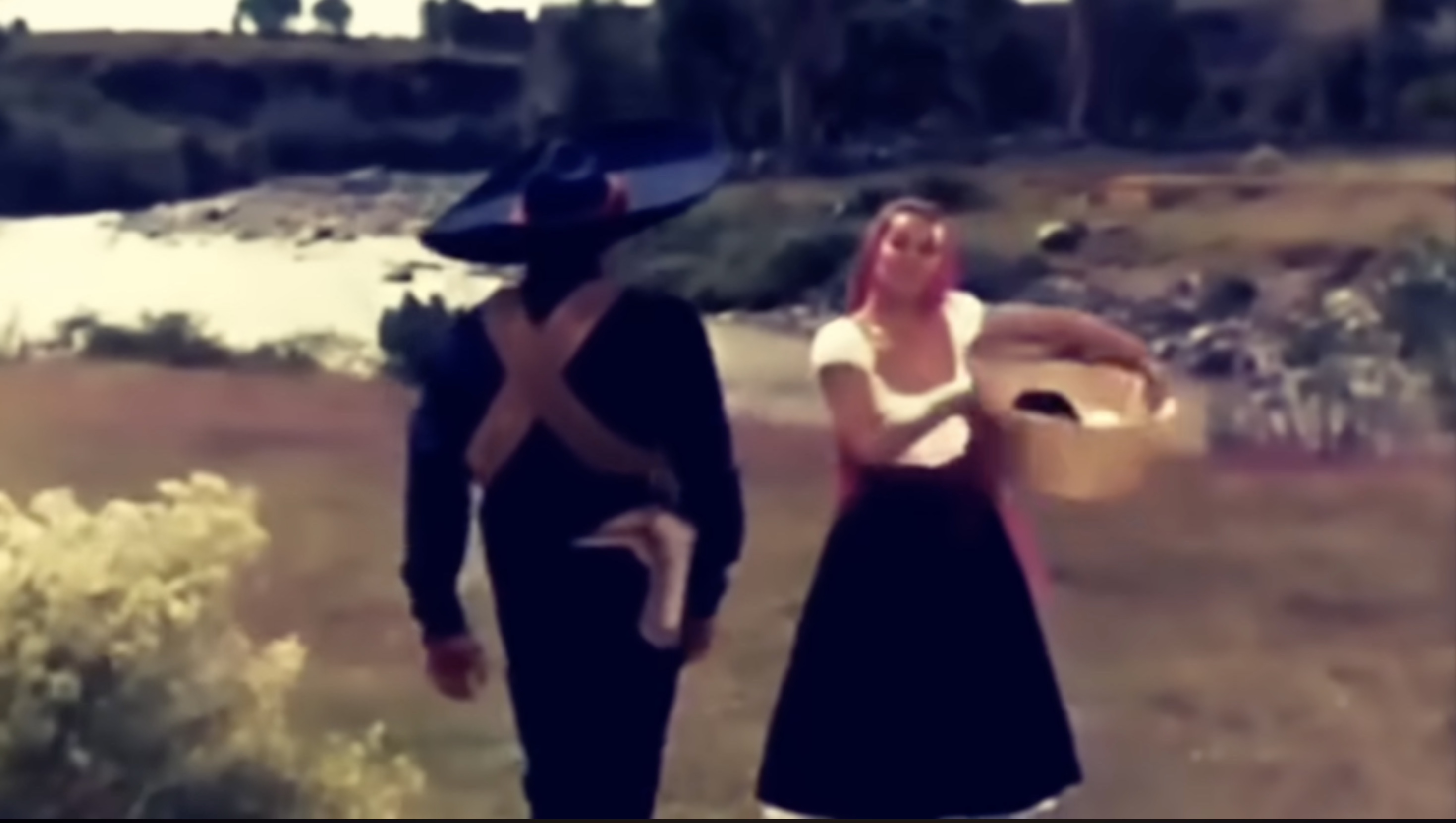
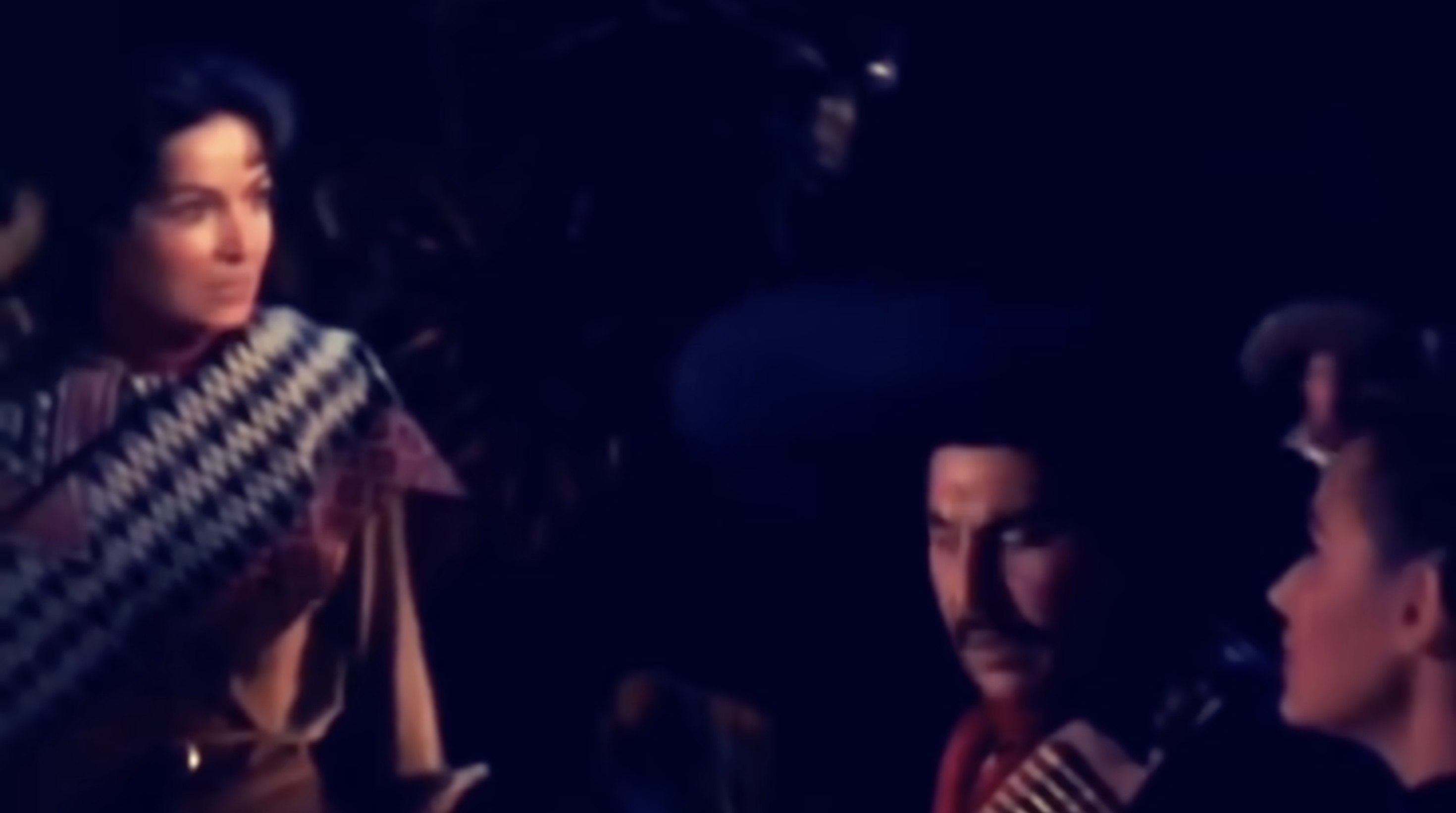
    Costume draws a clear line between three roles in the film. A man dressed entirely in black, with crossed bandolier straps and a broad sombrero, walks beside a woman in a lighter blouse carrying a woven basket. His dark, weaponized dress marks him as a soldier, hardened and armed. Her plainer clothing and domestic prop mark her as civilian, tied to everyday labor rather than combat. Cucaracha occupies a different register entirely. In a separate scene, she wears a bold, patterned poncho over a red neckerchief, paired with dramatic makeup and a hat worn at a confident angle, while a woman beside her fades into the background in plainer, more muted clothing. Cucaracha isn't dressed like the austere soldier, and she isn't dressed like the quiet civilian either. Her costuming is loud and built to hold attention, closer to performance than practicality. That places her in a third category the film keeps returning to: a woman who has made herself impossible to overlook, on either side of the line between soldier and civilian.
    Timecode
    8:04
    Film Still
    Still from La Cucaracha (1959) showing Cucaracha in a bold patterned poncho and wide-brimmed hat seated beside another woman in plainer clothing.
    Still from La Cucaracha (1959) showing a soldier in black with a crossed bandolier walking beside a woman in lighter clothing carrying a basket.
    Hair and Makeup
    Example
    Isabel's soft, glamorous styling vs. Cucaracha's perception
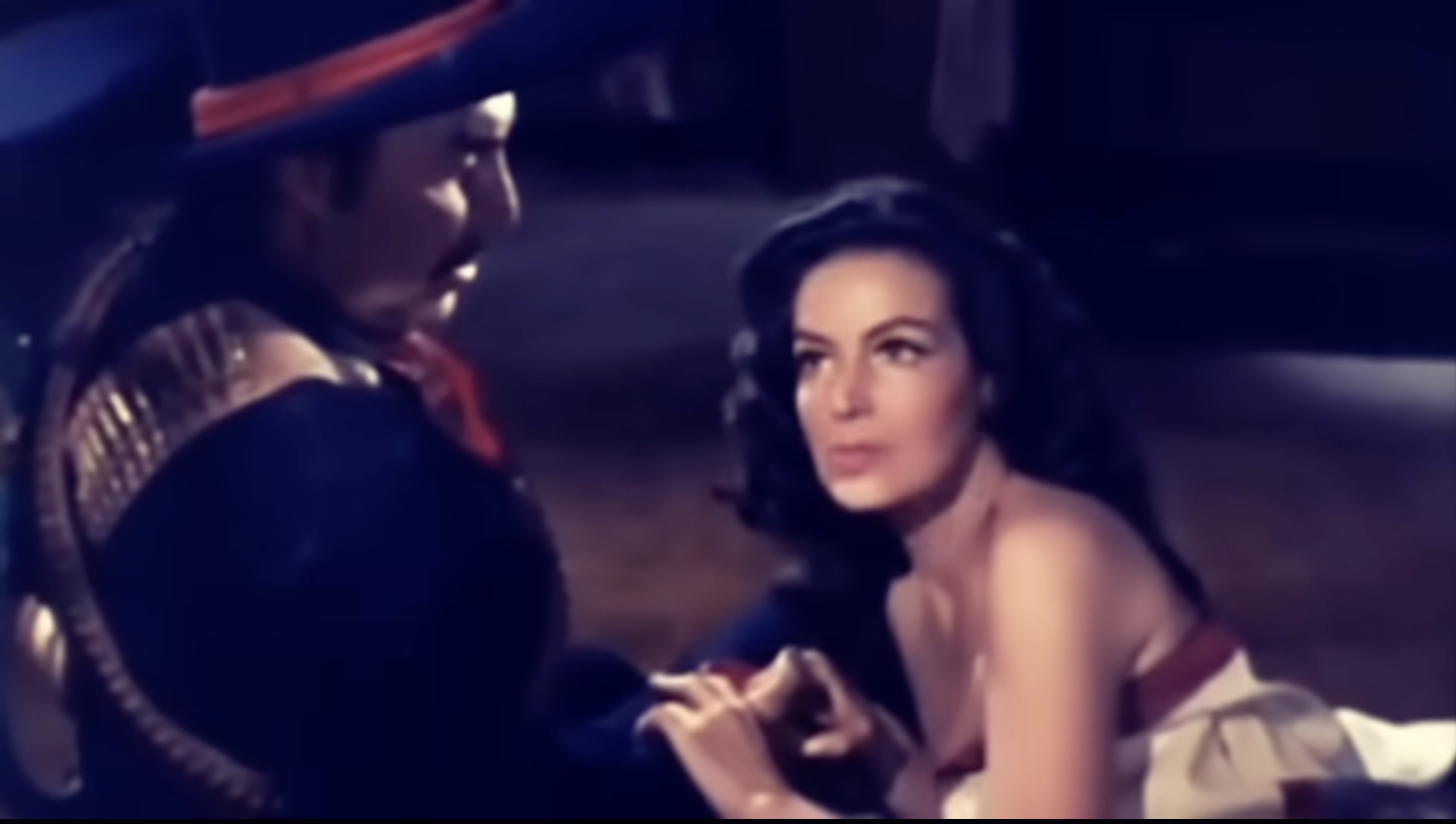
    Explanation
    Isabel's hair is loose and full here, dark waves falling past her shoulders, with a bare shoulder visible and minimal jewelry. Her makeup is soft but noticeable, defined brows, a full lip, and a warm glow to her skin that reads as intentionally glamorous rather than stripped down. It's a sharp contrast to how Cucaracha gets styled elsewhere in the film, where the look leans bold and armored instead of soft and exposed. This fits the same pattern established by the flower and Isabel's domestic coding throughout the film. She's presented as someone whose femininity is meant to read as vulnerable and desirable, not commanding, which lines up with how differently she and Cucaracha move through the story.
    Timecode
    59:28
    Film Still
    Still from La Cucaracha (1959) showing Isabel with loose, full hair and soft makeup in a close, intimate framing.
    Figure Behavior
    Example
    Cucaracha confronts Zeta and Isabel
    Explanation
    This shot puts all three points of the film's central triangle in the same frame. Cucaracha is positioned higher on the left, her arm raised as she gestures toward or above the other two, while Zeta and Isabel sit together lower in the frame, closer to each other than either is to her. The blocking does real work here. Cucaracha's elevation puts her above the couple both literally and symbolically, watching or confronting them from a position of visual dominance, while Zeta and Isabel are grouped together as a unit, their proximity to each other reinforcing the closeness that's been building between them. The scene stages the rivalry without needing dialogue to explain it. Cucaracha above and apart, Zeta and Isabel together and below, says almost everything about where the three of them stand with each other at this point in the film.
    Timecode
    1:09:59
    Film Still
    Still from La Cucaracha (1959) showing Cucaracha positioned above Colonel Zeta and Isabel in a nighttime confrontation, her arm raised toward the couple.
    Representative Clip

    This is the art of photography and visual storytelling in a motion picture or television show. Cinematography comprises all on-screen visual elements, including lighting, framing, composition, camera motion, camera angles, film selection, lens choices, depth of field, zoom, focus, color, exposure, and filtration. Cinematography sets and supports the overall look and mood of a film’s visual narrative. Each visual element that appears on screen, a.k.a. the mise-en-scène of a film, can serve and enhance the story—so it is the cinematographer’s responsibility to ensure that every element is cohesive and support the story. Filmmakers often choose to spend the majority of their budget on high-quality cinematography to guarantee that the film will look incredible on the big screen.

    Point of View
    Quality
    Framing
    Scale
    Movement

    Editing is the process of putting a film together–the selection and arrangement of shots and scenes. Editing can condense space and time, emphasize separate elements and bring them together, and organize material in such a way that patterns of meaning become apparent. In addition, editing can determine how a film is perceived: for instance, quick, rapid cuts can create a feeling of tension, while a long take can create a more dramatic effect. The first photoplays generally had no cutting, owing to the fact that they were single-reel films; once filming began, you could not stop until the film ran out. (https://filmglossary.ccnmtl.columbia.edu/term/editing/)

    Coherence, Continuity, and Rhythym
    Editing Style
    Transitions
    Match
    Expansion and Compression of Time
    Editing General Comments

    Sound is an integral part in a film. It refers to everything that the audience hears including sound effects, words and music. Sound is used in films for various purposes, including: providing the information to the viewer about the location of the scene, heightening the mood, telling the audience about the characters and advancing the plot. Every person who watches a film realizes that the choice of voices, soundtrack and music present in a film affect the way that the viewer perceives a particular film. As a result, the sound is an important and integral element of the film, one that determines the way that the viewer experiences and understands a film as a visual experience.

    Sound Type

    Narrative analysis is an examination of the story elements, including narrative structure, character, and plot. A narrative can be considered to be the chain of events in a cause-effect relationship occurring in time and space. In order to analyze the narrative of a film, we need to first make the distinction between the plot of the film and the story of the film. This is sometimes referred to as the discourse and story of a film. Narrative may also be called the story thought story mainly refers to the events that describe the narrative.

    Plot Comments
    Story Comments
    Narrator Type
    Narrative Structure

    Film genres are various forms or identifiable types, categories, classifications or groups of films. (Genre comes from the French word meaning "kind," "category," or "type"). These provide a convenient way for scriptwriters and film-makers to produce, cast and structure their narratives within a manageable, well-defined framework. Genres also offer the studios an easily 'marketable' product, and give audiences satisfying, expected and predictable choices. Genres refers to recurring, repeating and similar, familiar or instantly-recognizable patterns, styles, themes, syntax, templates, paradigms, motifs, rules or generic conventions.

    Category