Ahí Está el Detalle

    Release year
    1940
    Director
    Juan Bustillo Oro
    Biography of director(s)
    Juan Bustillo Oro was a Mexican film director, screenwriter, and producer who was one of the most important individuals in the Golden Era of Mexican film
    Country
    Mexico
    Original synopsis of the film

    This comedy follows the character Cantinflas and his misadventures in the house of Cayetano. The story begins as Cantinflas waits for his girlfriend, Paz (the maid of the Cayetano household) to signal for him to enter the Cayetano mansion to eat (as he usually does, without the knowledge of the house's patrons). This time, however, Paz demands that her boyfriend kill the Cayetano family dog Bobby, who has suffered a sudden onset of rabies, before he is allowed to eat. After he kills the dog Cantinflas becomes trapped inside the mansion due to the early return of Cayetano, the head of the household. Meanwhile, Dolores, the wife of Cayetano, is also inside with her ex-boyfriend Bobby who plans to blackmail her. Cayetano believes his wife is cheating on him and searches the house for her supposed lover. Paz hides both Cantinflas and Bobby, but when Cayetano arrives Bobby makes an escape and only Cantinflas is found. Dolores claims that Cantinflas is her long-estranged brother Leonardo, and Cayetano, who wants more of his wife's family's inheritance, treats Cantinflas lavishly. Trouble arises when Leonardo's partner Clotilde arrives with all of their sons, who have come also to deal with the issue of inheritance, and asks that they become a married couple. Before they can wed, police arrive looking for Leonardo who has allegedly killed Bobby (the blackmailer). Cantinflas confesses to having killed Bobby (the dog) and is put on trial. Finally, the real Leonardo appears and reveals that he had killed Bobby (the human) because he was being blackmailed - Cantinflas is allowed to go free and returns to his old antics, including waiting outside Cayetano's mansion for food. 

    Describes the setting of a scene in a play or a film. It refers to everything placed on the stage or in front of the camera—including people. In other words, mise en scène is a catch-all for everything that contributes to the visual presentation and overall “look” of a production. When translated from French, it means “placing on stage.”

    Setting
    Setting
    Explanation
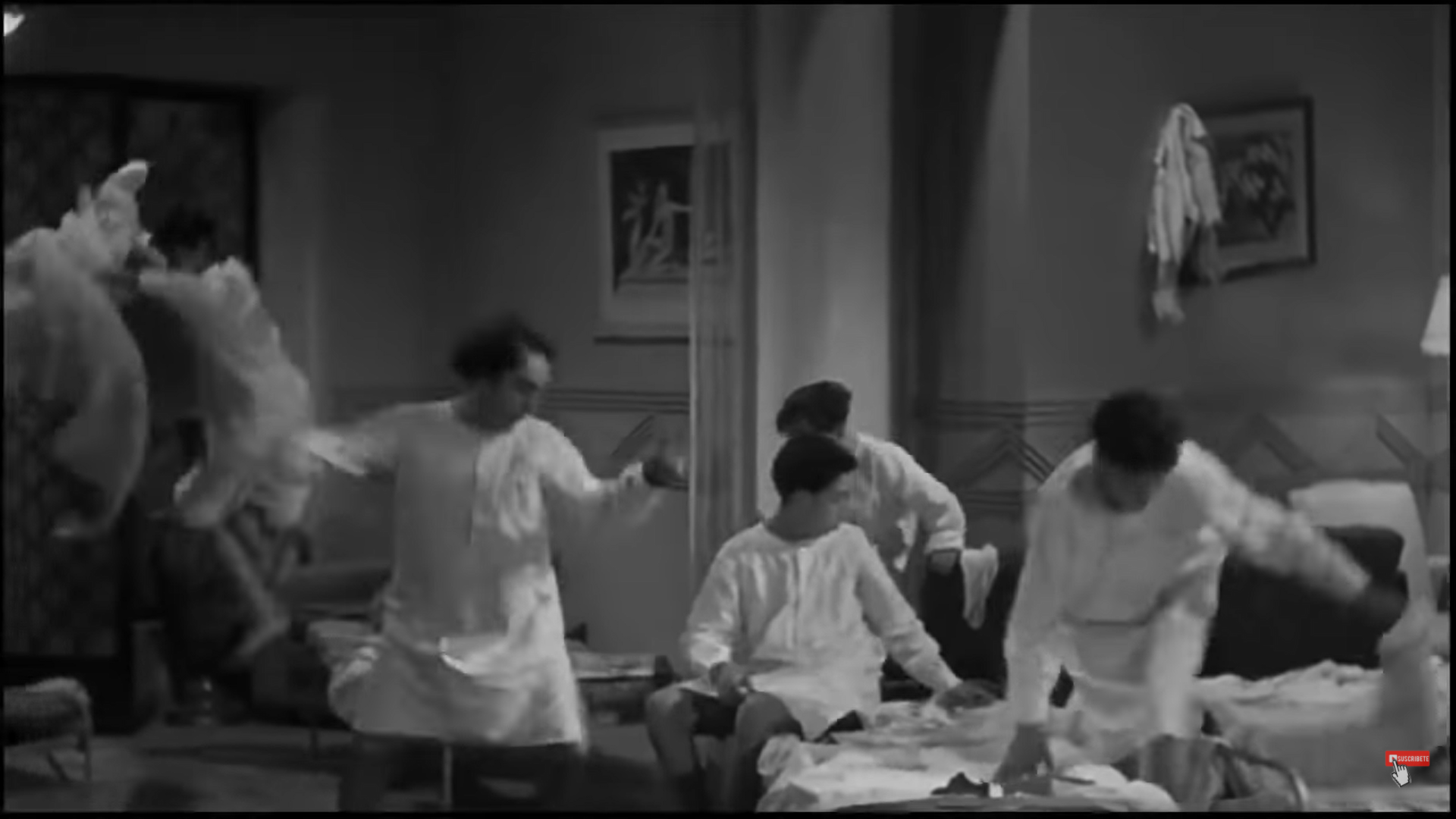
    Esta película usa el espacio para demostrar el estado mental de los personajes. Al principio, cuando las mentiras de Cantinflas todavía no le han metido en problemas, todos los espacios son muy ordenados, y cada cuadro se parece bien compuesto y planeado.

    Pero después de que las mentiras de Cantinflas empiezan a causar problemas, los cuadros se ponen desordenados y parecen ser más como una foto instantánea de acción.

    Pero al final, cuando todos los problemas de Cantinflas se han resuelto, los cuadros vuelvan al estado ordenado y compuesto. Así que cuando hay confusión y caos resultando del comportamiento de Cantinflas, se nota en el desorden y caos de cada cuadro; en cambio, cuando las mentiras de Cantinflas todavía se están desarrollando o ya se han resuelto, se nota en la planificación y orden de cada cuadro.
    Film Still
    Orderly setting when Cantinflas' lies have not yet caused issues.
    The lies of Cantinflas have begun to snowball, leading to a disorderly setting.
    Cantinflas' situation has been resolved, allowing the setting to become orderly again.
    Costume
    Explanation
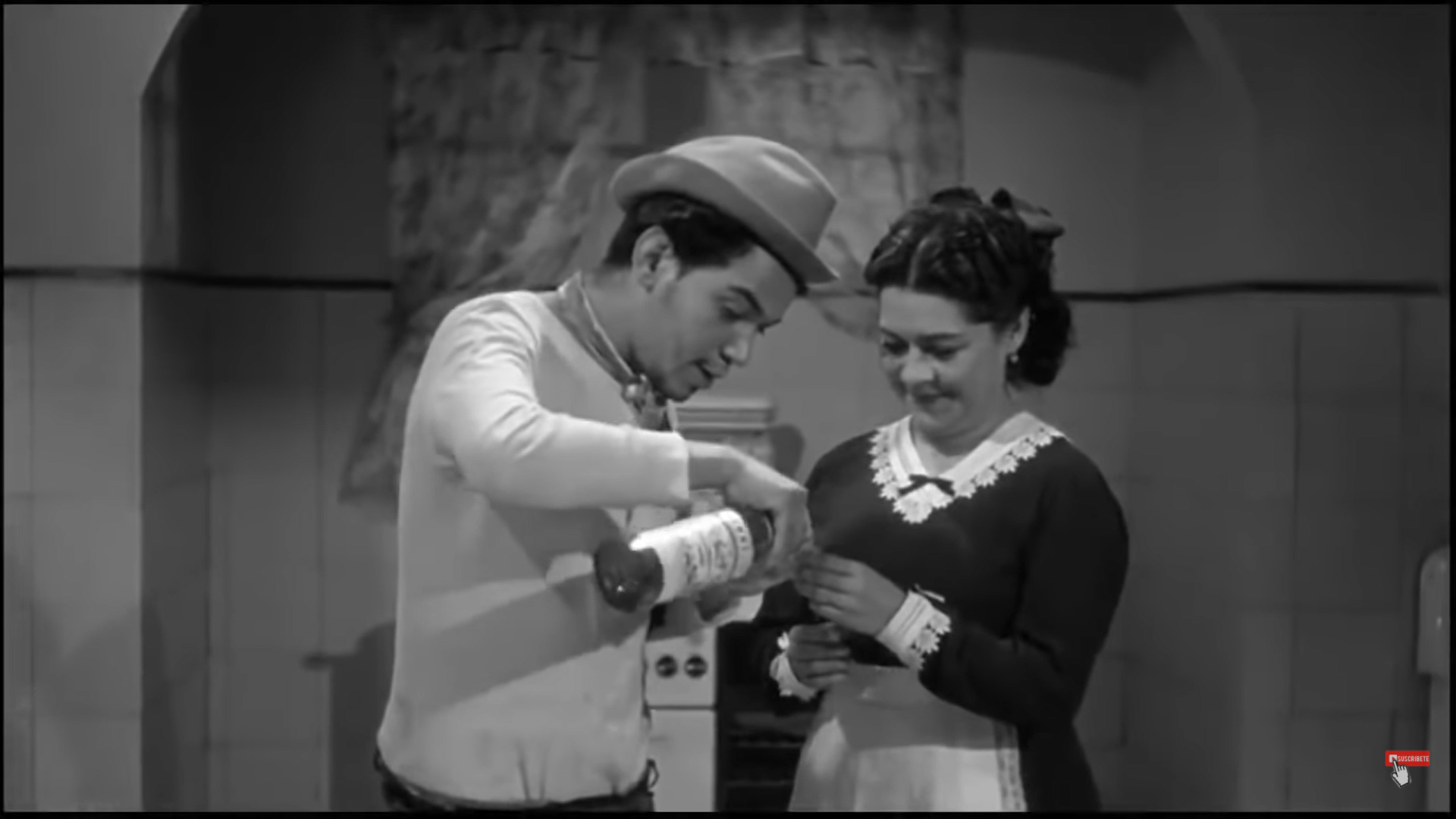
    La mayor parte de la ropa de esta película es realista y muestra el estatus social de los diferentes personajes. Uno de los cambios de ropa más importantes es cuando Cantinflas comienza a hacerse pasar por Leonardo: agrega ropa más elegante (como una bata) sobre su ropa "vagabunda".

    Este es un énfasis sutil al hecho de que solo está fingiendo: al final del día (o al final de la película, en este caso), regresa a su vida de vagabundo y a la misma ropa con la que comenzó la película. El resto de los personajes tienen un estilo bastante básico para el tipo de película; los ricos visten trajes y vestidos bonitos, la sirvienta usa su delantal, etc. En general, el efecto de los diferentes trajes es enfatizar la diferente posición social de los personajes y cómo se colocan en relación entre sí.
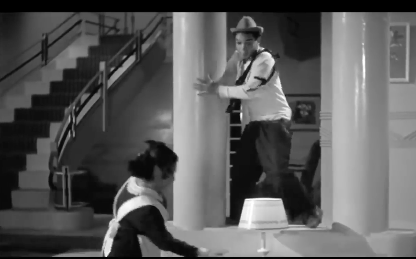
    Film Still
    Cantinflas has on simple clothes.
    Cantinflas puts Don Cayetano's fancier clothes over his simple clothes.
    Figure Behavior
    Explanation
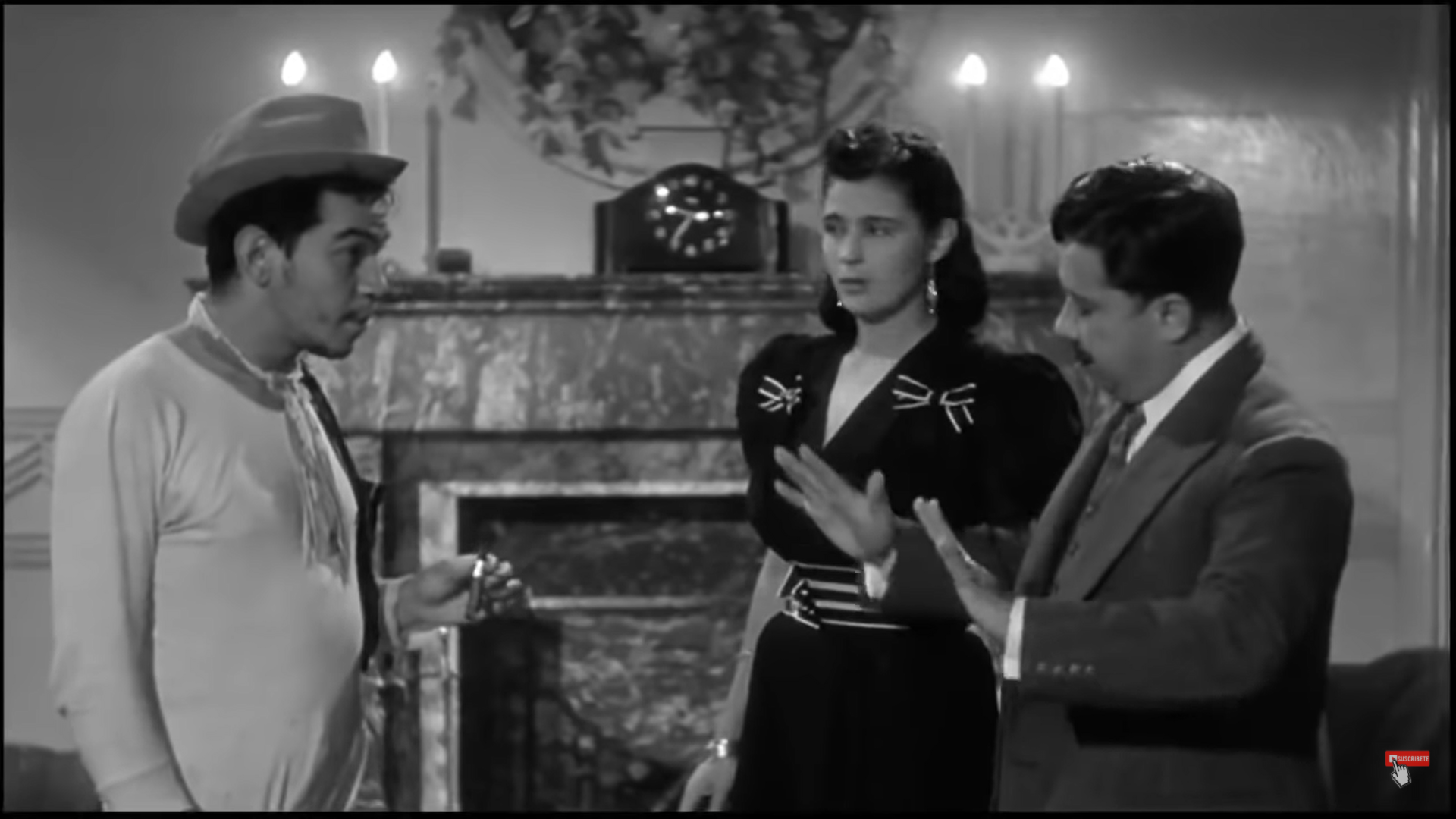
    Actores famosos hacen su aparición en esta película, y sus nombres aparecen en la pantalla desde el principio. Este estilo de comedia utiliza expresiones y movimientos faciales dramáticos para transmitir las emociones de la escena en particular. Esto se ve en el cuadro que se muestra abajo.

    El melodrama ayuda a exagerar los sentimientos presentes en la escena, cuando Cayetano y Dolores escuchan los disparos. Durante la mayor parte de la película, la cámara está al nivel de los ojos con todos los actores colocados en el centro del fotograma. Esto disipa cualquier ambigüedad potencial sobre lo que los personajes podrían estar sintiendo: todo se muestra con claridad y se enfoca en el centro de la pantalla para maximizar el efecto cómico. Con respeto a la mirada, la mayoría de los personajes se miran unos a otros o, de nuevo, miran a la cámara para mostrar su expresión facial. En general, la actuación y la coreografía de esta película se utilizan para mostrar el humor icónico de Cantinflas.
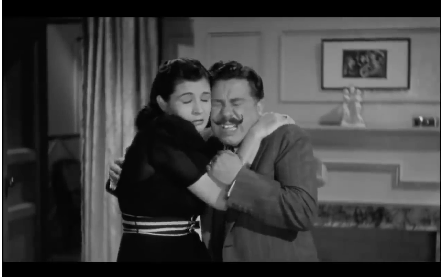
    Film Still
    Don Cayetano and Dolores react in a very exaggerated way with extreme facial expressions.
    Representative Clip

    This is the art of photography and visual storytelling in a motion picture or television show. Cinematography comprises all on-screen visual elements, including lighting, framing, composition, camera motion, camera angles, film selection, lens choices, depth of field, zoom, focus, color, exposure, and filtration. Cinematography sets and supports the overall look and mood of a film’s visual narrative. Each visual element that appears on screen, a.k.a. the mise-en-scène of a film, can serve and enhance the story—so it is the cinematographer’s responsibility to ensure that every element is cohesive and support the story. Filmmakers often choose to spend the majority of their budget on high-quality cinematography to guarantee that the film will look incredible on the big screen.
    Quality
    Quality
    Comments
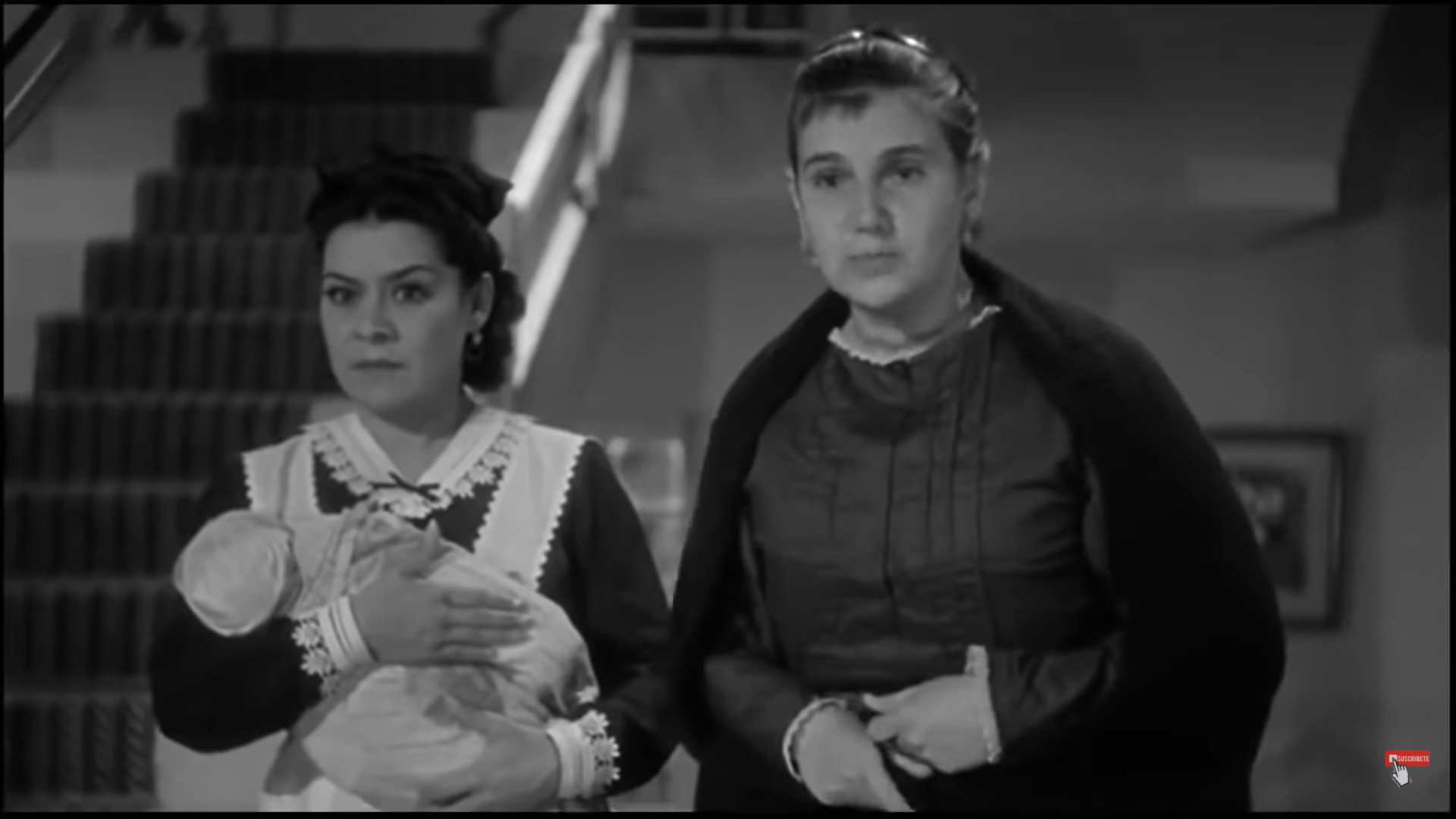
    The photography uses a normal lens with a shallow focus, allowing characters to remain in focus while the background behind them is slightly blurred. This choice pushes the viewer to concentrate on the characters as they converse, while still leaving the background in enough focus that it provides context, but not too much focus that it would distract from the conversations of the characters. In addition, there are no special effects such as superposition, as the film wants to be as easy to follow as possible, so that the maximum number of people can enjoy the movie.
    Film Still
    A shot of Paz and Clotilde in focus with a mildly blurred background.
    Framing
    Comments
    The camera is aimed straight on to the characters, a medium distance away. These factors make it easy and simple to observe the movie’s conversations and the body language of the characters’ reactions. The camera follows the action, panning slightly when characters move to the side. Aside from when the characters themselves move, the camera does not move. A rare example of this camera movement can be seen when Don Cayetano backs out of the way, telling Cantinflas and Dolores to hug (47:03 to 47:07, https://youtu.be/bpxwENDSOzA?t=2823). The camera approaches Cantinflas and Dolores, rotating slightly to face them directly, thus highlighting the discomfort on Dolores’ face. This camera movement and rotation is not common, as much of the movie consists of conversations where the characters stand in place. Most shots do not last very long, as the film cuts to whoever is talking so that viewers can easily follow the conversation, as seen from 47:07 to 47:50. These shots are all from the point of view of a third-party observer, and serve to show characters’ reactions to conversations. These camera and framing decisions are based on the film’s desire to appeal to a large variety of audiences; the use of simple techniques makes the material easy to understand.
    Timecode
    47:03 - 47:50
    Film Clip

    Editing is the process of putting a film together–the selection and arrangement of shots and scenes. Editing can condense space and time, emphasize separate elements and bring them together, and organize material in such a way that patterns of meaning become apparent. In addition, editing can determine how a film is perceived: for instance, quick, rapid cuts can create a feeling of tension, while a long take can create a more dramatic effect. The first photoplays generally had no cutting, owing to the fact that they were single-reel films; once filming began, you could not stop until the film ran out. (https://filmglossary.ccnmtl.columbia.edu/term/editing/)

    Coherence, Continuity, and Rhythym
    Comments
    The rhythm and pace of the movie is generally smooth yet fast-paced. There aren’t very many shots where the camera lingers on a particular character or has any sort of aesthetic, cinematic shot that helps set the scene; each scene is unambiguous and consists almost exclusively of conversations/interactions between the characters. This once again demonstrates how continuity editing is used in this movie. Although the majority of the movie uses rapid cuts, one must not ignore the few instances in which a scene “dissolves” into another. An example of this is seen in minutes 1:25:49 - 1:26:29. https://youtu.be/bpxwENDSOzA?t=5147 The fade-out from Cantinflas being arrested into the scene where Cantinflas is in the courtroom shows the progression of the timeline without having to include every little moment between the transition from the house to the courtroom. As mentioned previously, there aren’t many of these types of cuts within the scope of the full movie; however, scenes like this one are important to the continuity editing process to allow for the passage of time to occur without having to shoot every in-between moment of the two scenes. In general, this results in smooth transitions and allows the movie to be generally fast paced, with the mix of direct cuts within a single scene to fade-out transitions like this one quickly demonstrating time passing.
    Timecode
    1:25:49 - 1:26:29
    Film Clip
    Editing Style
    Editing Style
    Comments
    Continuity editing is used in this movie to show the consistency of the storyline. The story itself is pretty straightforward in that it follows a chronological chain of events surrounding Cantinflas, so there is little need for different types of editing. As mentioned previously, most of the shots are used to introduce a character to the scene; however, the quick cuts are also used to shift between scenes between different groups of characters that are happening somewhat simultaneously. This is seen in minutes 54:45 - 55:05, where Cantinflas and Cayetano are talking, with Cantinflas sitting on the couch and Cayetano standing above him (https://youtu.be/bpxwENDSOzA?t=3281). A cut from their conversation to the conversation between Dolores and Paz shows how the storyline is progressing; the way Dolores and Paz are positioned almost mirrors that of Cayetano and Cantinflas, emphasizing how continuity editing can move the story forward by establishing similar shots that are occurring around the same time.
    Timecode
    54:05 - 55:05
    Film Clip
    Transitions
    Comments
    There aren’t very many gradual changes within this movie; the majority of transitions are simple cuts from one character to another. Because this movie is mostly centered around the dialogue between characters, there is little movement within the frame once the shot is established. In the example between minutes 17:39 and 18:04, we can see how quick cuts are used to introduce characters to the particular scene. https://youtu.be/bpxwENDSOzA?t=1059 After we see Dolores watch the car drive away, a short cut to Paz is used to introduce her presence in the scene. One more cut then establishes her place in the scene next to Dolores, where they both remain in frame for the conversation. This demonstrates how the instantaneous changes from one shot to another mostly function as an explanation for characters entering and exiting the scene; there aren’t very many fade-ins or dissolving shots because the majority of the storyline is described in a straightforward manner.
    Timecode
    17:39 - 18:04
    Film Clip

    Sound is an integral part in a film. It refers to everything that the audience hears including sound effects, words and music. Sound is used in films for various purposes, including: providing the information to the viewer about the location of the scene, heightening the mood, telling the audience about the characters and advancing the plot. Every person who watches a film realizes that the choice of voices, soundtrack and music present in a film affect the way that the viewer perceives a particular film. As a result, the sound is an important and integral element of the film, one that determines the way that the viewer experiences and understands a film as a visual experience.

    Sound Type

    Narrative analysis is an examination of the story elements, including narrative structure, character, and plot. A narrative can be considered to be the chain of events in a cause-effect relationship occurring in time and space. In order to analyze the narrative of a film, we need to first make the distinction between the plot of the film and the story of the film. This is sometimes referred to as the discourse and story of a film. Narrative may also be called the story thought story mainly refers to the events that describe the narrative.

    Plot Comments
    Story Comments
    Narrator Type
    Narrative Structure

    Film genres are various forms or identifiable types, categories, classifications or groups of films. (Genre comes from the French word meaning "kind," "category," or "type"). These provide a convenient way for scriptwriters and film-makers to produce, cast and structure their narratives within a manageable, well-defined framework. Genres also offer the studios an easily 'marketable' product, and give audiences satisfying, expected and predictable choices. Genres refers to recurring, repeating and similar, familiar or instantly-recognizable patterns, styles, themes, syntax, templates, paradigms, motifs, rules or generic conventions.

    Category